Mental Models
Mental Models: Frameworks for understanding the world that help you make better decisions and solve problems more effectively. This guide introduces key mental models like Second-Order Thinking, Pareto Principle, First Principles Thinking, and Inversion, and shows how MindMax helps you apply them with AI assistance.
- Mental models are simplified representations of how the world works
- Key models include Second-Order Thinking, Pareto Principle, First Principles Thinking, and Inversion
- The mental models library contains 188 models across 6 categories
- MindMax integrates mental models as AI analysis frameworks
- Building a diverse mental model "latticework" improves decision quality
- AI can help you apply mental models to real problems more effectively
Frameworks for Understanding the World
Why do some people seem to make consistently better decisions or grasp complex situations more quickly? Often, the difference lies in their mental toolkit – specifically, their understanding and application of mental models. This guide introduces the concept of mental models, highlights some powerful examples, and shows how MindMax can help you learn, visualize, and apply them.
What are Mental Models?
A mental model is simply an explanation of how something works. It's a concept, framework, or worldview that you carry in your mind to help you understand the world and make decisions. Think of them as simplified maps of reality stored in your brain.
Key Characteristics:
- Simplification: They reduce complex realities into understandable frameworks.
- Incompleteness: No single model perfectly represents reality; they are approximations.
- Evolvability: Your understanding of models can deepen, and you can acquire new ones over time.
We all use mental models unconsciously, but consciously learning and applying a diverse range of robust models can dramatically improve our thinking.
Why Learn and Apply Mental Models?
Building a "latticework" (as Charlie Munger calls it) of mental models offers significant advantages:
- Understand Complex Systems: Grasp the underlying dynamics of situations in business, science, or everyday life.
- Make More Accurate Predictions: Better anticipate the consequences of actions or events.
- Avoid Cognitive Biases: Recognize common thinking traps and make more rational choices.
- Facilitate Cross-Disciplinary Learning: Apply concepts from one field (like physics) to understand problems in another (like economics).
- Improve Decision Quality: Equip yourself with proven frameworks for analyzing situations and choosing the best course of action.
Examples of Powerful Mental Models
There are hundreds of mental models across various disciplines. Here are a few fundamental ones:
- From Decision Making:
- Second-Order Thinking: Considering the consequences of the consequences of your actions, not just immediate effects. Crucial for strategic decisions.
- First Principles Thinking: Breaking down a problem into its most basic, fundamental truths and reasoning up from there, rather than relying on analogy or convention. Powerful for innovation.
- Inversion: Looking at problems backward by considering what would cause failure. Applications include identifying potential pitfalls and improving strategies.
- Pareto Principle (80/20 Rule): Roughly 80% of effects come from 20% of causes. Useful for prioritizing effort.
- Circle of Competence: Focusing on areas of expertise and knowing the boundaries of your knowledge. Applications include making informed decisions within your domain of expertise.
- Margin of Safety: Building a buffer between your assumptions and reality to absorb being wrong. Example: Building bridges stronger than needed.
- From Problem Solving:
- 5 Whys: Asking "why" five times in sequence to move from symptom to root cause.
- Working Backwards: Start from the ideal end-state and work back to identify the steps required to reach it.
- Scientific Method: Observe, hypothesize, predict, experiment, analyze. The most reliable engine for truth.
- From Creative Thinking:
- SCAMPER: Generate ideas by systematically Substituting, Combining, Adapting, Modifying, Putting to other uses, Eliminating, and Reversing.
- Six Thinking Hats: Rotate through six distinct thinking modes to avoid groupthink.
- Design Thinking: A human-centered five-stage creative process: Empathize → Define → Ideate → Prototype → Test.
- From Psychology/Decision-Making:
- Confirmation Bias: The tendency to search for, interpret, favor, and recall information that confirms pre-existing beliefs. Awareness helps combat it.
- Availability Heuristic: Overestimating the importance of information that is easily recalled (e.g., recent or vivid events).
If you want a practical way to explore this library, start with a path that matches your goal:
- Markets and business: Pareto Principle, Second-Order Thinking help you reason about pricing, trade-offs, efficiency, and growth.
- Systems and change: Inversion, Margin of Safety, and First Principles Thinking help you see resilience, unintended consequences, and intervention points.
- Judgment and decisions: Second-Order Thinking, Confirmation Bias, Availability Heuristic, and First Principles Thinking help you challenge assumptions and improve decision quality.
This is just a small sample. The goal is to build a diverse collection.
How to Build Your Mental Model Latticework
Acquiring and internalizing mental models is a lifelong pursuit:
- Read Widely: Explore foundational books and concepts across different fields (psychology, economics, physics, biology, history).
- Reflect on Experience: Analyze your successes and failures through the lens of different mental models.
- Learn from Others: Study how successful thinkers and leaders apply these concepts.
- Apply Actively: Consciously try to use relevant models when analyzing problems or making decisions.
How MindMax Helps You Master Mental Models
MindMax provides a unique space to engage with and apply mental models:
- Apply Models to Cases: When analyzing a specific problem or case study, explicitly pull in relevant mental model frameworks. Use them to structure your analysis.
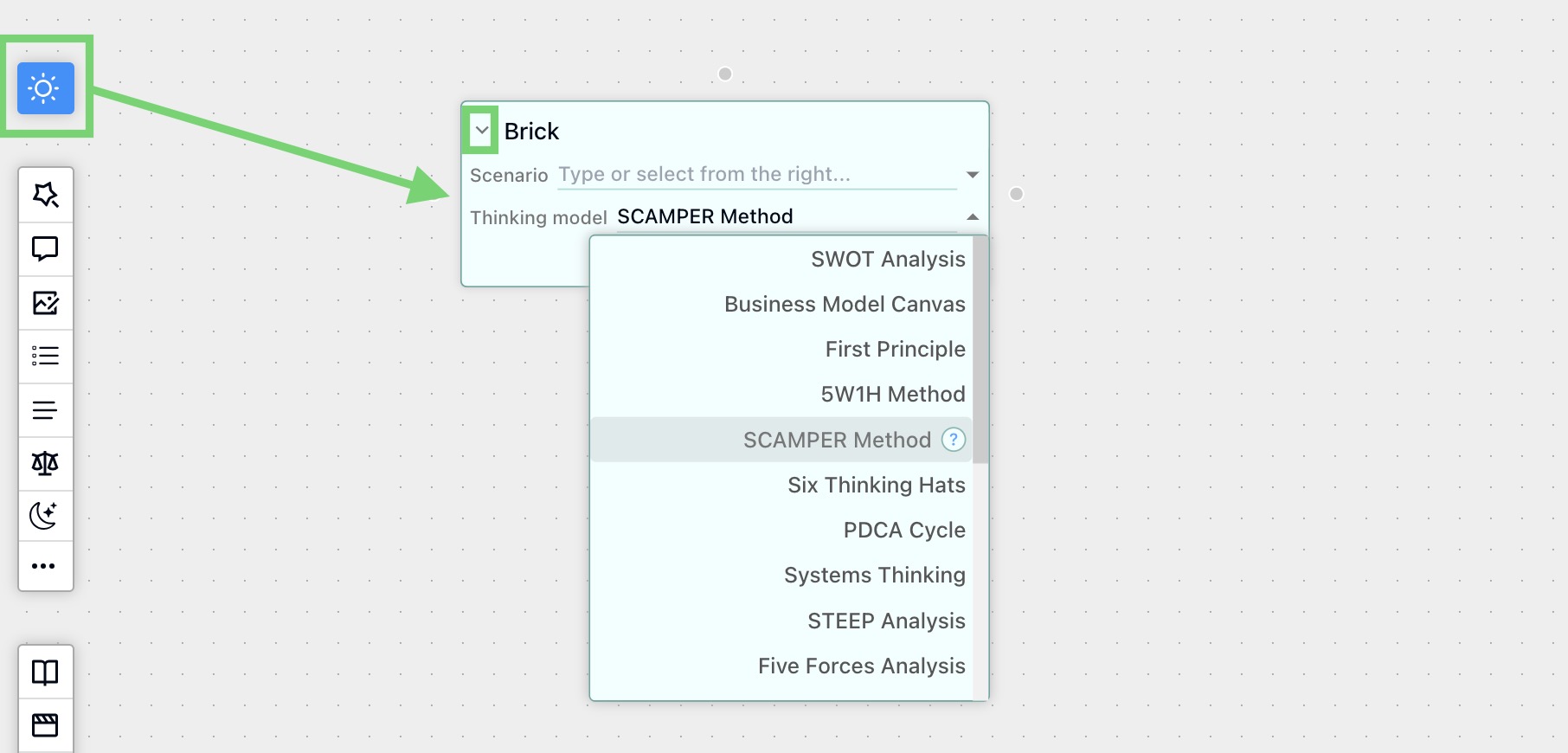
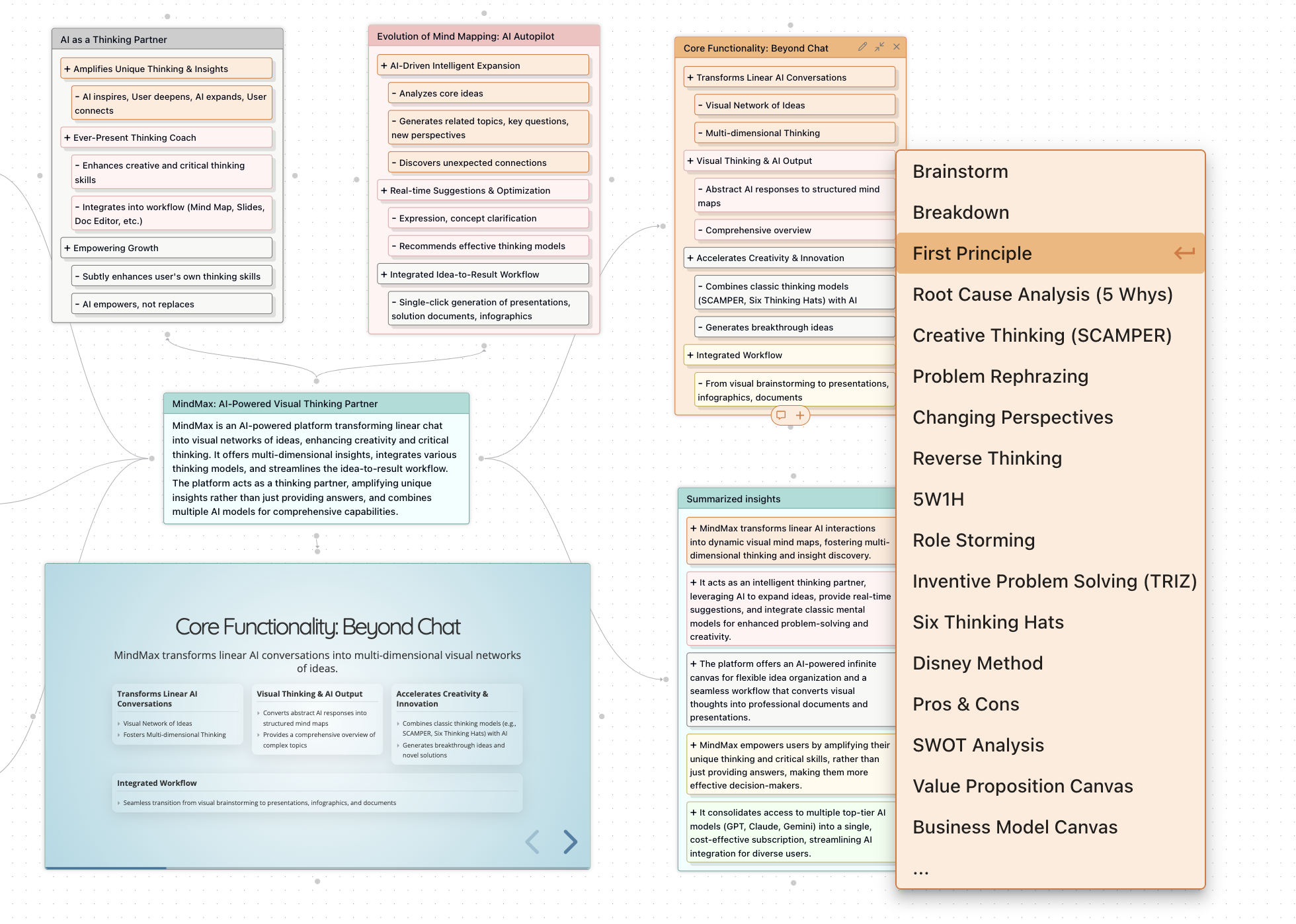
- Idea Generation for Any Topic: With the MindMax mindmap, you can brainstorm ideas on any subject using pertinent mental models. Simply hover over the item and click the ideation button on its right side.
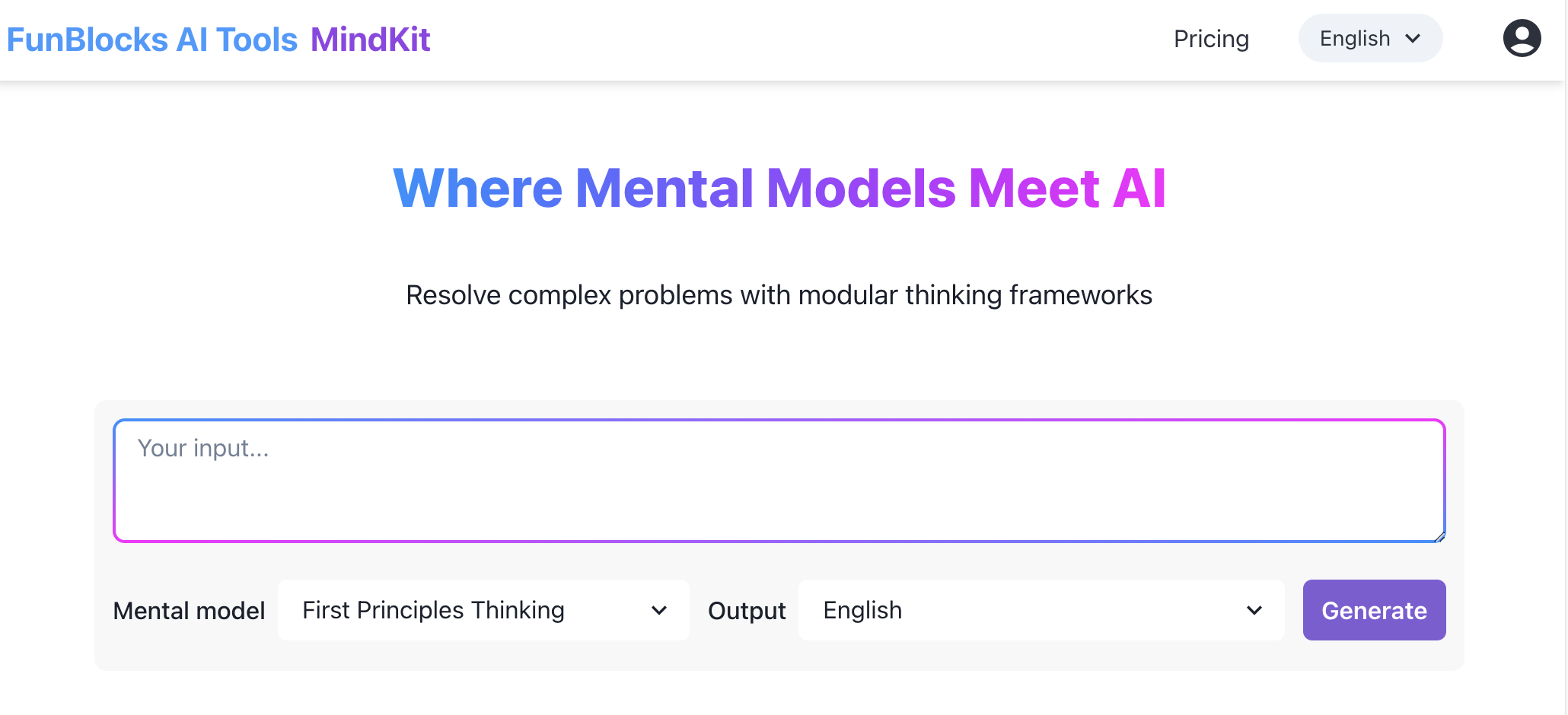
- FunBlocks AI Tools - AI MindKit: Based on MindMax, FunBlocks AI Tools offers a convenient application specifically designed to facilitate the use of mental models for topic exploration, problem analysis and resolution.
Summary & Continuous Learning
Mental models are powerful tools for thinking more clearly and effectively. Building your latticework takes time and effort but yields immense rewards.
Use MindMax Workspace to visualize, organize, and actively apply these frameworks to real-world challenges. Enhance your decision-making toolkit today! See how all these methods come together in our Integrated Workflow Guide.
If you want to begin from source material instead of a blank canvas, start with AI MindMap Generator to turn webpages, PDFs, videos, or text into a structure you can keep testing with mental models.
Further reading
Enhancing Decision-Making Through Mental Models in the AI Age
Mental models are powerful frameworks that help us make sense of the world and make better decisions. In today's fast-paced environment, combining these cognitive tools with generative AI can significantly enhance our problem-solving and creative thinking capabilities. This article explores how mental models work, why they're essential, and how modern AI technologies can amplify their effectiveness.
Mental Models: Definition and Importance
Mental models are internal representations of external reality that we use to understand and navigate the world. They consist of interconnected beliefs that shape our expectations and how we interpret the way things work. Simply put, mental models provide simplified explanations of how things operate.
The importance of mental models lies in their ability to:
- Facilitate better decision-making
- Help avoid potential problems
- Uncover new opportunities
- Guide our perceptions and behaviors
- Aid in understanding complex systems
- Provide structure for organizing information
- Improve learning and memory
Mental models serve as the foundation for how we understand and interact with the world. They act as cognitive frameworks that simplify complexity and guide our actions. Developing diverse mental models is crucial for effective thinking and decision-making processes.
Common Mental Models and Their Applications
A variety of mental models can be applied across different disciplines to enhance problem solving and analysis:
First Principles Thinking: Breaking problems down to fundamental truths and reasoning up from there. Applications include problem-solving and innovation.
Second Order Thinking: Considering the long-term consequences of decisions by asking "And then what?" Applications include risk assessment and strategic planning.
Inversion: Looking at problems backward by considering what would cause failure. Applications include identifying potential pitfalls and improving strategies.
Confirmation Bias Awareness: Recognizing the tendency to favor information that confirms existing beliefs. Applications include improving objectivity in decision-making.
Margin of Safety: Building buffers to account for unexpected events. Applications include risk management and financial planning.
Occam's Razor: The simplest explanation is usually the best. Applications include problem-solving and analysis.
Circle of Competence: Focusing on areas of expertise and knowing the boundaries of your knowledge. Applications include making informed decisions within your domain of expertise.
Pareto Principle (80/20 Rule): 80% of results come from 20% of causes. Applications include prioritization and resource allocation.
Systems Thinking: Understanding how different parts of a system interact and influence each other. Applications include analyzing complex problems and understanding interconnections.
These mental models provide different lenses through which to analyze situations and make better decisions. Each model offers a unique perspective, from fundamental principles to understanding human behavior and complex systems.
Learning and Applying Mental Models in Various Contexts
To effectively utilize mental models for creative thinking and ideation:
Build Your Mental Models Toolbox: Expose yourself to various models from different disciplines through reading and learning.
Select Appropriate Models: Assess situations and choose the right models to guide your thinking process.
Practice Application: Apply mental models to everyday situations and challenges to strengthen your understanding.
Employ First Principles Thinking: Break complex problems down to core truths for better analysis.
Conduct Thought Experiments: Explore the implications of ideas without constraints to enhance creative thinking.
Engage in Second-Order Thinking: Consider the long-term consequences of actions to improve decision quality.
Try Inverting Problems: Look at situations from the opposite perspective to gain new insights.
Learning mental models is an active process that involves both acquiring knowledge of different models and practicing their application in real-world scenarios. Combining different models can provide a more comprehensive understanding of complex problems.
The Value of Mental Models in Understanding Complex Systems and Making Decisions
Mental models offer significant value in problem solving and decision-making:
Simplifying Complexity: Mental models help break down complex systems into understandable chunks.
Improving Decision Quality: They provide structured approaches to thinking and evaluating options, leading to more informed choices.
Enhancing Problem-Solving Abilities: The ability to view problems from different angles helps identify innovative solutions.
Organizing Information: Mental models help categorize and structure knowledge for better analysis and application.
Predicting Outcomes: They assist in anticipating potential consequences of different actions.
Reducing Bias: Mental models provide frameworks for more objective analysis, helping avoid common cognitive biases.
These frameworks are invaluable for navigating complexity and making effective decisions. They provide structure for understanding, analyzing, and predicting outcomes across various situations.
Enhancing Mental Models with Generative AI
The advent of generative AI has created new opportunities to leverage mental models more effectively:
AI-Assisted Model Exploration: Use AI tools to discover and learn about mental models relevant to specific problems. For example, ask an AI to explain how the "Tragedy of the Commons" might apply to your business scenario.
Dynamic Visualization: AI can help visualize complex systems and relationships by creating interactive diagrams that show how components interact according to different mental models.
Scenario Generation: Leverage AI to generate multiple potential outcomes based on different mental models, helping you consider a broader range of possibilities than you might on your own.
Bias Detection: AI can help identify potential cognitive biases in your thinking process by analyzing your decision patterns and suggesting alternative mental models to consider.
Personalized Model Recommendations: AI systems can learn which mental models have worked best for you in similar past situations and recommend appropriate frameworks for new challenges.
Collaborative Thought Experiments: Use AI as a thought partner to explore the implications of applying different mental models to your problem, helping you see angles you might have missed.
Using Mental Models and AI to Enhance Strategic Thinking
The combination of mental models and AI creates powerful opportunities for strategic analysis and creative problem solving:
Model-Based Decision Trees: Create AI-generated decision trees that apply various mental models (like SWOT analysis or Porter's Five Forces) to evaluate different strategic options.
First Principles Exploration: Use AI to explore the first principles of your business or industry to identify potential areas for innovation and creative thinking.
Scenario Planning: Build AI-powered scenario planning exercises that represent various future states and apply mental models like "antifragility" to evaluate resilience.
Collaborative Model Application: Leverage AI to facilitate the application of different mental models among team members, gaining diverse perspectives on strategic challenges.
Mental Model Training: Use AI to create personalized training programs that help you and your team internalize and apply specific mental models more effectively in your problem-solving processes.
Cross-Disciplinary Ideation: AI can help connect mental models from different disciplines to your specific challenge, sparking innovative thinking and novel solutions.
By combining the cognitive power of mental models with the computational capabilities of AI, we can significantly enhance our strategic thinking, ideation processes, and decision-making abilities in ways previously not possible.
Conclusion
Mental models provide invaluable frameworks for understanding complex systems and making better decisions. By building a diverse toolkit of these thinking models and learning to apply them appropriately, we can improve our problem-solving abilities, enhance creative thinking, and make more informed choices.
The integration of generative AI with mental models represents the next frontier in decision-making and analysis. This powerful combination allows us to explore, apply, and benefit from mental models in ways that were previously impossible, opening new possibilities for strategic thinking and creative problem solving in the AI age.
To stay competitive in today's complex world, developing proficiency with mental models and leveraging AI to enhance their application should be a priority for anyone looking to improve their thinking and decision-making capabilities.
Table 1: Common Mental Models and Their Applications in MindMax
| Mental Model | Description | MindMax Application |
|---|---|---|
| First Principles | Breaking problems down to fundamental truths | Use mind maps to decompose problems layer by layer to core elements |
| Second-Order Thinking | Considering long-term consequences | Use multi-layer branches to analyze direct and indirect impacts of decisions |
| Inversion | Thinking from the opposite angle | Set goal as center, branch out to explore factors leading to failure |
| Confirmation Bias | Recognizing preference for information supporting existing beliefs | Actively seek information contradicting your viewpoint, record on canvas |
| Margin of Safety | Building buffers for unexpected events | Reserve extra resources or time in planning, visually represent on canvas |
| Occam's Razor | Simplest explanation is usually best | Compare complexity of different explanations, choose the most concise solution |
| Circle of Competence | Focus on areas of expertise | Mark the scope of your expertise when making decisions |
| Pareto Principle | Identify the critical 20% | Analyze which factors produce 80% of results, highlight on canvas |
| Systems Thinking | Understanding how parts of systems interact | Use mind maps to represent systems, their components and relationships |
| Availability Heuristic | Note biases from easily recalled events | Deliberately seek less easily recalled but potentially important information, record on canvas |